2018 Tax Brackets

2018 Income Tax Brackets and Standard Deduction Rates

The Tax Cuts and Jobs Act (TCJA) was signed into law by President Donald Trump on December 22, 2017.  With its passage many tax payers were given some much needed tax relief.  Notable changes include:

•  Elimination of personal exemptions

•  Elimination of the “Pease” limitation on itemized deductions

•  Expansion of the Child Tax Credit

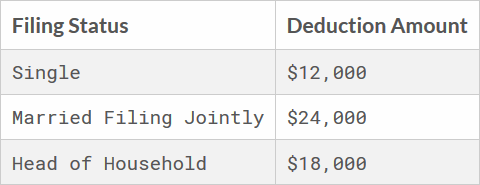
•  Standard deduction for single filers increased by $5,500 and by $11,000 for married couples filing jointly (see Table 2 below)

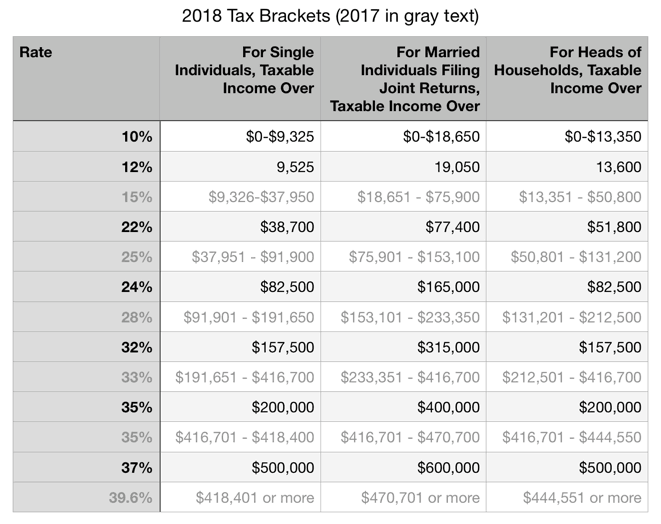
•  Tax table changes (see Table 1 below)

To protect individuals that are pushed into higher income tax brackets due to reduced value from credits and deductions instead of increase in real income (known as “bracket creep”), the act also requires that the IRS adjust numerous tax provisions for inflation.


Table 1. 2018 Income Tax Brackets and Rates


Table 2. 2018 Personal Exemption and Standard Deduction

The personal exemption for 2018 is eliminated


Child Tax Credit

The Child Tax Credit under TCJA is worth up to $2,000 per qualifying child.  The age cut-off stays at 17 (child must be under 17 at the end of the year for taxpayers to claim the credit).  The refundable portion of the credit is limited to $1,400.  This amount will be adjusted for inflation after 2018.


Tax Season 2019

Spring of each year is a dreaded time for most Americans as tax returns are due, and unlike last year when the due date landed on a Sunday allowing an extra couple days for taxpayers to mail in their returns, the date to file personal returns is Monday April 15th, 2019.  It may sound off into the distant future but rest assured it will be here before you know it.  So we recommend reviewing what information you currently have and getting organized now to get ahead of any potential issues.  Of course, many of you will not be able to prepare your return this early as you are awaiting year-end statements and other tax related documents (e.g. 1099’s and W2’s).  Notwithstanding, it’s advisable to start preparing for the 2019 Tax Season now.  Here are some tips to help you get organized and ready for next years tax season:

1. Create a Checklist

The best way to get started is with a Checklist, and the best way to create your list is by using your most recent filed tax return to help jog your memory of the various forms and schedules you will need to prepare for.   As the corresponding tax related documents and statements arrive for each form you can check them off your list.

 

2. Collect tax related documents

Well-organized records make it easier to prepare a tax return and help provide answers if your return is selected for examination or if you receive an IRS notice. The IRS requires you to keep records, such as receipts, canceled checks, and other documents that support an item of income, a deduction, or a credit appearing on a return as long as they may become material in the administration of any provision of the Internal Revenue Code, which generally will be until the period of limitations expires for that return.

The IRS also recommends the following:

Property Records

Keep records relating to property until the period of limitations expires for the year in which you dispose of the property in a taxable disposition. You must keep these records to figure your basis for computing gain or loss when you sell or otherwise dispose of the property.

Healthcare Insurance

You should keep records of your own and your family members’ health care insurance coverage, including records of employer-provided coverage or premiums paid and type of coverage for private coverage, so you can show that you and your family members had and maintained required minimum essential coverage. If you’re claiming the premium tax credit, you’ll need information about any advance credit payments you received through the Health Insurance Marketplace, the premiums you paid, and the type of coverage you obtained at the Marketplace. If you or any of your family members are exempt from minimum essential coverage, you should retain certificates of exemption you may receive from the Marketplace or any other documentation to support an exemption claimed on your tax return.

Business Income and Expenses

If you’re in business, there’s no particular method of bookkeeping you must use. However, you must use a method that clearly and accurately reflects your gross income and expenses. The records should substantiate both your income and expenses. If you have employees, you must keep all your employment tax records for at least 4 years after the tax becomes due or is paid, whichever is later.

3. Find a Tax Preparer

It doesn’t really matter whether you are an individual or a business owner, you will need tax planning and preparation strategy that includes tax saving tactics and strategies like insurance strategies, employee benefit plans, financing alternatives and more. All these things can be overwhelming for an ordinary person, but the experts in this field like TaxPM are doing this on a daily basis for dozens of individuals and businesses.


Got mail (from IRS)? Don’t Panic…

It can be a terrifying experience when you go to retrieve your mail, and among the usual bills and junk mail, there is the “dreaded” plain white envelope from the Internal Revenue Service.  Like most Americans you get this uneasy feeling in your gut and the anxiety sets in.


Don’t Panic, the IRS sends out millions of letters to taxpayers every year, most of these are automated. Notwithstanding, you should open the letter immediately as many of these notices must be addressed by specific due dates.  Ignoring these notices or putting them off could worsen the situation, especially if they are disputing money owed, they can rapidly rack up interest and penalties! However, as mentioned before these notices should not always be the cause for concern.  The IRS send out notices for a host of reasons, first thing to do is understand the reason for the notice.

Why was I notified by the IRS?

The IRS sends notices and letters for the following reasons:

    • You have a balance due.
    • You are due a larger or smaller refund.
    • We have a question about your tax return.
    • We need to verify your identity.
    • We need additional information.
    • We changed your return.
    • We need to notify you of delays in processing your return.

Once you have identified the reason for the notice maintain calm, and read it very carefully. If you are unsure how to proceed or simply prefer to have more experienced person address the IRS on your behalf, contact the professionals at TaxPM™ today!

Here are some recommended actions that the IRS advises if you’ve received a letter from them.

Read

Each notice or letter contains a lot of valuable information, so it’s very important that you read it carefully. If they changed your tax return, compare the information we provided in the notice or letter with the information in your original return.

Respond

If your notice or letter requires a response by a specific date, there are two main reasons you’ll want to comply:

  • to minimize additional interest and penalty charges.
  • to preserve your appeal rights if you don’t agree.

Pay

Pay as much as you can, even if you can’t pay the full amount you owe. You can pay online or apply for an Online Payment Agreement or Offer in Compromise. Visit IRS payments page for more information.

Keep a copy of your notice or letter

It’s important to keep a copy of all notices or letters with your tax records. You may need these documents at a later date.

Contact IRS

They provide their contact phone number on the top right-hand corner of the notice or letter. Typically, you only need to contact them if you don’t agree with the information, if they requested additional information, or if you have a balance due. You can also write them at the address in the notice or letter. If you write, allow at least 30 days for their response.

The location of the notice or letter number

You can find the notice (CP) or letter (LTR) number on either the top or the bottom right-hand corner of your correspondence.

When the notice or letter looks suspicious

Please visit IRS Report Phishing page if you receive a notice or letter that looks suspicious and was designed to appear as though it came from the IRS. You can also call 800-829-1040. The IRS never ask taxpayers for personal information via e-mail or social media.


1099 or W-2?

There is always a constant misunderstanding of what forms need to be filed on a tax return when a company pays a worker to perform a service or labor under their company name. The two common forms are a W-2 or 1099-Misc. Most people who have worked for a franchise or a global named company have been given a W-2 at the end of each employment year. Because the W-2 is the most common form out of the two, business owners assume that the tax form W-2 is given to every worker but it is not always the case.

Filing a W-2

The tax form that needs to be filed can be one of the two but depends on the situation and status of the person through the eyes of the company. The tax form W-2 is for those who are an employee of the company. One of the key differences between the two tax forms is with a W-2 the business owner assumes the responsibility to deduct the taxes on the wages they are paying their employees and reports and pays the tax deducted to the Internal Revenue Service (IRS). The deductions are composed of State Income Tax, Federal Income Tax, Social Security, and Medicare; comprised these are commonly referred to as payroll taxes. There is another consideration that needs to be made if the company controls the person’s schedule and it’s providing the workers with necessary tools and training to complete a task a specific way then the worker is classified as an employee, in which the company must report this income to the IRS and furnish it’s employee(s) with a W-2 form.

Filing a 1099-Misc.

A 1099-Misc. form is furnished to workers that are considered an independent contractor. These workers are not considered employees of the business, so the worker oversees calculating their own payroll tax and submitting their own income earnings to the Internal Revenue Service (IRS) and Social Security Administration on a quarterly basis. To be considered an independent contractor, the worker contributes its own time, completes task-based projects on their own ideas and styles, the worker provides him or herself with their own tools, materials, and other supplies to complete the task. Another consideration in filing a 1099-Misc. is that the worker needs to make more than $600 in one fiscal year or it is not necessary to provide them with a 1099-Misc.

Wrong Classification

The Internal Revenue Service has developed a new form for employees who have been misclassified as independent contractors by an employer. Form 8919, Uncollected Social Security and Medicare Tax on Wages, will now be used to figure and report the employee’s share of uncollected social security and Medicare taxes due on their compensation.

IRS: Tax-related Identity Theft

About 1 in every 16 people living in the United States has been a victim of identity theft. Identity theft occurs when someone uses another person’s identity information like their names, social security number (SSN), or credit card number without the other persons consent. USA today announced that “identity theft soared during 2016 and in fact, it has hit an all-time high.”

The issue of identity theft has been a focal point for the IRS(Internal Revenue Services) since tax payers have too many times been victims of tax-related identity theft and refund fraud. As you may have guessed, a tax-related identity theft occurs when someone uses your stolen Social Security number to file a tax return to benefit on a fraudulent refund. To stop these tax-related identity theft, the IRS has assigned more than 3,000 employees to work on identity theft-related issues, and provides its 35,000+ employees training on how to detect identity theft.

The IRS is working hard to prevent identity theft and has stopped 14.6 million suspicious returns and protected over $50 billion in fraudulent returns. One of the steps they take is by calling tax payers to verify some questions they have on tax returns or refund amounts. The doing of this process is not to alarm any tax payer of fraud but to be proactive, if any fraudulent act was taken. It might sound like a simply task but it is a very effective way to find out if theft has occurred.

What can you do as Taxpayer?

If you are an e-filer, do your research. Search the internet, find out if the website you are thinking to use, has not been hacked or is a scam to get your personal information. If you are not an e-filer, and use a tax consultant, make sure files can not be easily stolen or seen. Also, keep your information hidden from others who do not need to know your personal information.

On the IRS website, it states that red flags should go up if any of the following occur:

  1. More than one tax return was filed using your SSN
  2. You owe additional taxes, or refund offsets on years you have not filed.
  3. IRS records show that you have received wages from an employer you did not work for.

If you have been a victim of tax-related identity theft, contact the IRS.